
Most urban plans endure for a few decades before they begin to unravel. What remains and what fades is determined by a fundamental distinction: while some projects are conceived as a visual layer imposed upon the city, others continue to perform because they were designed to become part of its operational structure.
Since 1975, Beeah has built its practice on a clear conviction: the longevity of the urban fabric emerges from the logic of place and the relationships that define it, not from visual impact alone. This conviction evolved into what we call Authenticity of Form—a methodology that enables urban plans to move beyond immediate needs, adapt to growth and transformation, and retain their effectiveness over time.
The following three projects remain active and relevant within today’s urban landscape, offering tangible evidence of the enduring value of this approach.
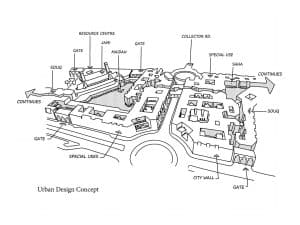
Model One: Diplomatic Quarter Central Area Plan – Riyadh
In 1980, Beeah undertook the planning of this district at a time when cities were largely shaped by the logic of the automobile: wide arterial roads, isolated building masses, and underutilized public spaces. This approach challenged that pattern and restored the role of the pedestrian within the city.
This was more than a planning project; it was an act of urban rescue. The work moved beyond fragmented interventions and established an integrated urban framework that restored the human dimension amidst the dominance of asphalt, without compromising operational efficiency.
This transformation did not merely alter the physical environment; it established an exceptional degree of flexibility that has endured for more than four decades. While many conventional plans struggled to accommodate expansion, this framework successfully adapted to highly sensitive diplomatic and security requirements without losing its organizational clarity or balance.
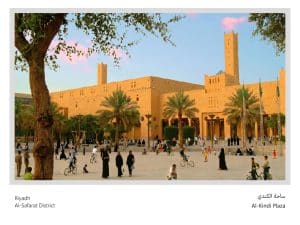
Al-Kindi Plaza — Aga Khan Award for Architecture, 1989
One of the most enduring outcomes of this urban framework was Al-Kindi Plaza, a public space that has maintained a vibrant presence since its inception. It was recognized with the Aga Khan Award for Architecture as a model that successfully reconciled human scale with the broader demands of the urban fabric.
Here, the relationship between shade and open space is carefully articulated. Pathways widen, gathering spaces vary in character, and movement unfolds within a coherent framework defined by clarity of form and harmony of elements.Today, the plaza can still be read through the details of its everyday use. Crowds move through its pathways, groups settle within shaded areas, and social interactions emerge along its edges. It is a living environment that continually renews itself through its users, affirming that public space fulfills its purpose when shaped around human experience.
Model Two: King Abdulaziz Historical Center – Riyadh
In the early 1990s, Al-Murabba District was facing fragmentation within its urban fabric. A significant earthen heritage associated with the history of the Kingdom and its founder stood surrounded by vast and disconnected open spaces lacking both functional definition and visual coherence.
As preparations began for the centennial commemoration of the Kingdom’s founding by King Abdulaziz—may he rest in peace—the challenge extended beyond urban development. It became a race against time to deliver an urban achievement worthy of a defining national milestone. Beeah was entrusted with delivering a transformative intervention within only thirteen months.
The project was not conceived as a conventional restoration effort. Rather, it redefined the relationship between heritage and contemporary use. Historic structures were not treated as isolated museum artifacts; they were integrated into an active urban framework. A coordinated movement system connected museums, plazas, and gardens, transforming urban fragmentation into a coherent whole.
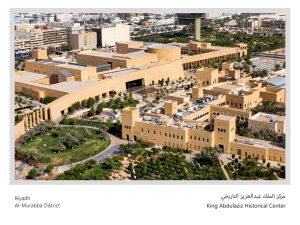
Today, the center spans more than 440,000 square meters and continues to operate as a cohesive cultural landscape, accommodating large seasonal gatherings without compromising the efficiency and functionality of its daily use.
Officially inaugurated in January 1999, the project did not rely on superficial historical imitation. Instead, authentic materials were employed within contemporary technical solutions, ensuring the center’s continued relevance throughout successive phases of Riyadh’s growth. Its enduring success reflects the principles of the King Salman Charter for Architecture and Urbanism, balancing the preservation of local identity with the evolving demands of contemporary urban development.
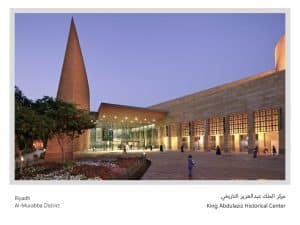
The ability of these spaces to accommodate major gatherings and cultural events with the same efficiency decades after completion is a direct outcome of an Authenticity of Form approach to urban development.
Model Three: Central Area Redevelopment and Rehabilitation – Taif
In Taif, the challenge took a different form. The historic center did not suffer from a lack of identity; rather, it faced overlapping uses where vehicles and pedestrians shared the same routes, commercial activities intersected with centuries-old landmarks, and the area lacked a coherent visual framework capable of enhancing legibility and movement.
Beeah’s intervention emerged through a comprehensive planning framework based on a detailed reading of the place and a thorough analysis of its components. The plan identified priorities for intervention while highlighting areas suitable for future redevelopment and adaptive reuse.
Recognizing the gap that often emerges between proposals and implementation, the approach sought to anchor design in reality through solutions that considered budgets, property ownership conditions, and practical feasibility. As a result, the intervention moved beyond visual enhancement to become a lasting and implementable framework aligned with the existing logic of the place.
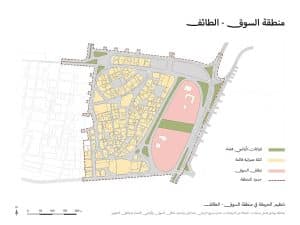
The Market District stands as one of the most significant examples of this transformation. As the focal point of movement and activity, it clearly demonstrates the impact of reorganizing circulation and redefining relationships between urban uses. The district retained its underlying logic while becoming clearer, more efficient, and more legible in its performance.
The Shared Methodology Behind the Three Models
These projects are not connected by a common period or a shared award. They are united by a more fundamental question:
Where does planning begin?
When design begins with form, its impact often ends with appearance. When it begins with movement patterns, services, and spatial relationships, it creates a structure capable of sustaining urban life over time.
As urban planners, our role extends beyond visual composition. It requires understanding the forces that shape cities, integrating transportation and mobility studies, evaluating their relationship to street design and movement efficiency, and ensuring compliance with the health, operational, and regulatory frameworks that govern urban development.
It also requires drawing upon accumulated expertise to understand spatial dimensions and develop alternatives that enhance the quality of urban environments. This principle lies at the heart of Beeah’s philosophy: Authenticity lies not in recreating forms, but in understanding the logic that produced them.
These projects reveal that the past is not a visual reference to be imitated, but a living system whose principles can be reactivated to inform the future.