

Does the design of a learning environment merely serve as a container for knowledge, or does it function as a living language that shapes learners’ awareness and guides the dimensions of their experience?
Educational architecture can be understood as a perceptual system in which spatial structure and cognitive experience are closely intertwined. Spatial awareness is formed through direct interaction with mass, light, and space, while spatial memory often recalls not the educational content itself, but the spatial impact that shaped first impressions of the surrounding environment. This implicit role of space in guiding collective perception highlights the professional need to reconsider design as a central perceptual tool within the educational process, particularly when addressing users with diverse sensory abilities and modes of spatial understanding.
The Role of Educational Architecture in Guiding Design
The concept of inclusive architecture begins with recognizing the diversity of perception within educational spaces. Rather than offering segmented solutions, it seeks to create unified environments that acknowledge varied perceptual abilities as a fundamental design consideration. Within this framework, inclusive design emerges as an approach that integrates sensory and movement-related considerations into spatial structure from the earliest design stages, enabling users to read and understand space without reliance on a single perceptual channel.
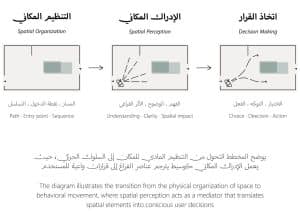
The value of this approach becomes evident in how clear circulation paths and spatial continuity support learning experiences and social interaction. Spatial organization plays a key role in shaping the relationship between users and the educational environment, positioning architectural decision-making as a foundational process rather than a set of technical or post-design interventions.
Perceptual Experience in Educational Environments
Sensory experience within educational spaces is not uniform; it intensifies at specific spatial thresholds that serve as key moments in understanding the environment. At entrances, intersections of circulation paths, and transitions between different functions, users engage directly with cues related to orientation, identity, and spatial connectivity.
At these design junctions, the essence of inclusive architecture becomes clear. Clarifying spatial relationships helps reduce cognitive effort, while the articulation of thresholds, spatial sequencing, and hierarchy between primary and secondary circulation routes supports ease of movement. These strategies extend beyond visual aesthetics to enhance users’ ability to navigate their surroundings, particularly for individuals who rely on non-visual perceptual cues.
Case Study: Blind Care Project – Muscat
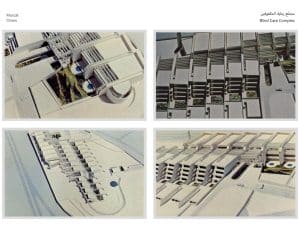
Within this applied context, the Blind Care Project in Muscat, implemented during the 1970s, represents one of the early examples of designing educational environments from a human-centered perspective that responds to users’ daily needs. The project was grounded in the understanding that educational spaces must be legible and easily interpreted, especially for users who depend on multiple senses to navigate the built environment.
The spatial organization connected the educational and residential buildings through a bridge that ensured continuity of daily movement. Interior spaces and circulation routes were arranged to emphasize directional clarity and spatial progression. Design elements such as variations in texture, airflow, and movement rhythm provided non-visual sensory cues that supported spatial understanding and independent navigation without reliance on direct signage.
The project later evolved into a practical reference used in academic and professional studies of educational environment design, demonstrating how carefully considered design decisions can leave a lasting impact on everyday lived experience.
The Cost of Ignoring Human Diversity
When design overlooks the diversity of its users, it loses part of its purpose. Many projects achieve high levels of formal completion yet fall short in delivering equitable usability in practice.
In 2018, London’s Crossrail stations—among the largest modern transportation projects—faced criticism due to accessibility challenges in some locations, highlighting the gap between execution quality and user experience. Similarly, a university case in the United States in 2019 revealed limitations of relying solely on visual guidance within educational buildings, leading to post-occupancy redesigns to address navigation difficulties experienced by visually impaired students.
These cases demonstrate that design shortcomings are not measured by what is seen, but by what is perceived and lived. When space is reduced to its visual dimension, human experience is excluded from the equation, resulting in costly corrective interventions that could have been addressed through informed design from the outset.
Institutional Awareness as a Framework for Architectural Practice
Institutional awareness provides the pathway for inclusive architecture to move from individual design efforts to an integrated practice that governs all stages of architectural production. Understanding human diversity within space requires an organizational framework that embeds these considerations into planning processes and decision-making logic.
In this context, national initiatives, universal access programs, and the Saudi Building Code have established regulatory frameworks that guide movement and sensory orientation in educational and public projects. These frameworks promote design decisions grounded in user experience rather than formal assumptions or post-design modifications, reflecting a broader societal understanding of quality and accessibility.
Within this perspective, inclusive design represents a professional extension in which experience emerges from an integrated system. Decisions are shaped by clarity, and quality is recognized as a shared value that respects and responds to human dimensions.