

Why Are Beginnings Read as Unstable?
In the early stages of professional formation, instability does not appear as an absence of vision, but rather as a state of cognitive fluidity that has not yet settled into a defined intellectual position. Multiple design approaches coexist without being organized within a regulating reference framework, making it difficult to distinguish between fluctuation resulting from limited experience and an early openness to diverse contexts.
This condition manifests in hesitation when attempting to fix a final stance, in the repeated testing of design decisions, and in an internal sense that each productive attempt remains closer to examination and learning than to the formulation of a complete model. Such uncertainty does not indicate a flaw in the trajectory; instead, it reflects a stage in which awareness advances through experimentation and review before stabilizing into a clear conviction.
The Investigative Approach in the Formation of Architectural Logic
With entry into actual practice, the architect confronts the complexity of work as it exists in reality, removed from its theoretical formulation. Possible approaches multiply, and none of them settles quickly as a final reference, since reading reality from more than one perspective becomes a gateway to understanding rather than an intellectual luxury.
Within this context, decisions become less direct. Experience reveals that every choice is bound to site conditions, patterns of use, and surrounding contexts, and that ready-made solutions rarely endure under such complexity. Here, a form of logic begins to emerge from practice itself, where the ordering of questions takes precedence over the haste to arrive at answers.

The Stabilization of the Intellectual Model Through the Continuity of Experience
As experience extends over time, it becomes clear that the formation of the intellectual model is not a decisive moment, but a long cumulative process. This model is shaped through repeated practice, varied situations, and the testing of decisions across different contexts.
Along this path, the architect gradually distinguishes between what can be relied upon as a stable reference and what should remain open to development. Over time, certain choices gain weight—not because they were declared as theory, but because they proved their capacity to endure through application.
Often, the architect does not recognize the completion of this model in the moment it forms, but discovers it later when reflecting on their professional trajectory, observing the coherence of decisions across different projects despite varying conditions. At that point, it becomes evident that what has taken shape is an internal logic that now guides choice almost instinctively.
The Expansion of Vision in the Formation of Architectural Awareness
As the scope of exposure widens, architectural awareness enters an additional phase of testing. Existing ideas are subjected to reconsideration, raising questions about their ability to withstand multiple references and broader contexts.
This transition does not lead to a loss of identity, but to its reordering. Comparing different modes of thinking and understanding variations in cultural and spatial conditions releases decision-making from the narrowness of a single perspective, granting the architect a greater ability to discern what truly suits a place and serves its use over the longer term.
With this expansion, identity does not recede; rather, it becomes clearer after being tested beyond its initial boundaries.
From Concept to the Management of Complexity
At this stage, preliminary models move beyond their role as provisional tools for development and become instruments for understanding how complexity is managed within the project. It becomes evident that while some elements can tolerate change, others require a degree of stability to maintain the coherence of the solution.
This understanding arises from practice that reveals the limits of possible intervention at each stage, transforming design from the assembly of separate components into an informed reading of interconnected relationships. The project becomes a single system in which modifying any one part affects the whole.
Here, design is no longer a search for an isolated solution, but for a logic of interrelation capable of responding to reality without losing balance.
Managing Interactions in the Design Act
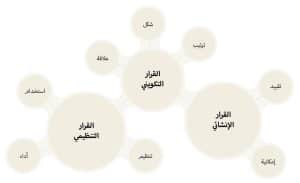
At this level of practice, design is understood as a process of coordinating simultaneous elements, each carrying a different weight and exerting a reciprocal influence on the overall composition of the project. Any structural, organizational, or formal decision is reconsidered within a network of interactions that shape the balance of the work as a whole.
In this sense, the architect’s role approaches that of an orchestra conductor, organizing elements and harmonizing their roles. Just as a conductor regulates the interaction of concurrent musical sections, the architect arranges structural, operational, and spatial elements so that they perform collectively within a unified framework. Excellence lies in the project’s ability to function as an integrated whole that absorbs variation among its components while maintaining equilibrium; its value emerges from the relationships between elements rather than from the prominence of any single component.
When viewing this trajectory in its entirety, it becomes clear that what is often understood at the beginning as confusion or dispersion is, at its core, part of a cumulative construction of professional logic. Instability serves as a sign of inquiry, the postponement of resolution allows ideas to be tested across multiple contexts, and intellectual openness expands reference frameworks rather than dissolving them.
From this foundation—rooted in continuous review—a balanced design practice takes shape, capable of advancing, pausing, and rereading itself whenever the nature of the stage requires.
Within this path, questions do not disappear; they change in nature.
And the question that remains present is: At which stage is your awareness forming today?